Case Study: VR Training for High-Risk Electrical Isolation & Lockout-Tagout (LOTO) Procedures in Oil & Gas Refineries

Deployed for a Fortune 500 Indian conglomerate in oil & gas with refinery operations across multiple sites


CLIENT SNAPSHOT

  • Industry: Oil & Gas / Energy / Petrochemicals
  • Scale: One of India’s largest private-sector conglomerates
  • Operating Environment: High-voltage electrical systems, multiple feeder networks, continuous process operations with 24/7 shift-based workforce
  • Training Mandate: Standardise and de-risk electrical isolation and LOTO training across sites and contractor teams


THE PROBLEM

Electrical feeder isolation is among the most safety-critical procedures in oil & gas refinery operations — a single misstep in the Lockout-Tagout (LOTO) sequence can result in arc flash incidents, equipment damage, or fatalities. The client’s existing training relied on SOP documentation, classroom instruction, and on-site walkthroughs, but this approach had clear operational limitations:

  • Trainees could not practice the full isolation sequence without shutting down live equipment, and retention of the correct procedural order was inconsistent — particularly among new joiners and contract workers rotating across sites.
  • Classroom instruction could not replicate the time pressure, spatial orientation, and hazard recognition demands of the actual feeder room environment.
  • Training delivery varied between sites and instructors, and there was no scalable mechanism to assess individual procedural readiness before allowing personnel onto live systems.

The client needed a training solution that could replicate the complete operational workflow in a controlled, repeatable, and measurable environment — without exposing trainees to live electrical hazards.


OUR APPROACH

Using the iQ3Connect extended reality platform, we designed and developed a fully immersive Virtual Reality training simulation that digitally recreates the client’s feeder isolation environment and replicates the end-to-end LOTO procedure with engineering-grade fidelity.

The solution was purpose-built around the client’s actual SOPs, site-specific equipment configurations, and safety protocols — not a generic off-the-shelf module. Every interaction, sequence gate, and failure condition in the simulation maps directly to the client’s operational reality.


The platform was structured around two distinct training modes:

  1. Guided Learning Mode. A step-by-step immersive walkthrough with real-time narration, visual prompts, and contextual safety guidance. The trainee is guided through each stage of the isolation procedure — from permit verification and PPE sequencing through breaker rack-out and voltage absence testing. This mode builds foundational competence and allows unlimited repetition without operational risk.
  2. Independent Assessment Mode. An unguided simulation where the trainee executes the complete procedure independently. The system silently validates every action, sequence, and safety step in real time. Missed steps, incorrect sequences, and safety violations are captured automatically. At the end of each session, the platform generates a structured competency report.


SCOPE OF SIMULATED WORKFLOW

The VR simulation covers the complete isolation lifecycle as performed in the client’s operational environment:

  1. Isolation permit and documentation verification
  2. PPE compliance check and correct safety gear sequencing
  3. Feeder identification and equipment state confirmation
  4. Control isolation and switching procedures
  5. Breaker rack-out and physical LOTO implementation
  6. Hazard recognition — identification of unsafe conditions in the environment
  7. Voltage absence testing and discharge procedures
  8. Safe maintenance handover to the working team

Each stage includes contextual decision points and failure paths. For example, if a trainee attempts to rack out a breaker without first confirming voltage absence, the simulation flags the violation and — in assessment mode — records it as a critical procedural failure.


ASSESSMENT & COMPETENCY TRACKING

The assessment engine was a key deliverable for the client. Beyond pass/fail scoring, it generates granular competency data that feeds directly into workforce planning and compliance processes.

Each completed assessment session produces a structured report capturing:

  • Procedural accuracy — whether all mandatory steps were executed correctly
  • Sequence compliance — whether steps were performed in the correct operational order
  • Safety violations — any PPE non-compliance, skipped verifications, or hazardous actions
  • Time-to-completion benchmarked against expected operational norms
  • Individual readiness scoring for clearance decisions

The platform was built to integrate with the client’s enterprise Learning Management System (LMS), enabling automated synchronisation of training records, assessment outcomes, and certification workflows across sites.


DEPLOYMENT STRATEGY

Given the client’s multi-site operations and distributed workforce, the solution was designed for flexible deployment across two delivery formats:

Immersive VR: Full simulation deployed on Meta Quest MR headsets for on-site training centres. This delivers the highest fidelity experience with spatial interaction, hand tracking, and full environmental immersion.

2D Desktop/Tablet: A parallel version of the same training module accessible via laptops and tablets. This enables remote access for employees at sites without VR hardware, contract workers during onboarding, and refresher training scenarios.

This hybrid approach allowed the client to deploy immersive training at primary refinery locations while extending reach to satellite offices, contractor pools, and remote teams without additional hardware investment.


RESULTS & OPERATIONAL IMPACT

The deployment delivered measurable improvements across training effectiveness, safety compliance, and operational efficiency:

Up to 40%
Improvement in procedural
retention vs. classroom
3X
More practice repetitions per
trainee per quarter
Zero
Live equipment exposure
during training
100%
Standardised delivery across
all sites
  • Trainees demonstrated significantly stronger recall of the correct isolation sequence and safety checkpoints, reducing reliance on SOP reference during live procedures.
  • Hands-on practice cycles increased substantially — trainees could repeat the full procedure multiple times in a single session, something impossible with live equipment walkthroughs.
  • Training delivery was fully standardised across sites, eliminating instructor-dependent variation and ensuring every operator received identical procedural instruction.
  • The assessment engine gave site safety leads a data-driven mechanism to evaluate individual readiness before granting live-system access, replacing subjective sign-off processes.
  • Dependence on planned maintenance windows for training was reduced, freeing operational schedules and decoupling training timelines from production cycles.
  • Contract and temporary workers could be onboarded and assessed remotely via the 2D module before arriving on site, reducing integration time.


This engagement demonstrated that VR is not limited to product visualization or equipment familiarization — it is a proven platform for digitizing, standardizing, and measuring compliance with complex, safety-critical operational procedures at enterprise scale. The iQ3Connect platform enabled rapid deployment across devices and sites, making immersive process training operationally viable for one of India’s largest industrial organizations.


Ready to Transform Your Customer Experience?

Discover how iQ3Connect can help your organization drive growth, resilience, and competitive advantage in the digital era.
Digital Customer Experience in Industrial Manufacturing: How Spatial Computing Is Redefining Growth, Resilience, and Profitability

The New Competitive Battleground: Digital Customer Experience

Industrial manufacturing and construction companies are undergoing a fundamental shift. According to Deloitte, enhanced digital customer experience is no longer optional—it’s “table stakes” for companies seeking growth, differentiation, and resilience. (Deloitte)

Today, 93% of industrial companies are already implementing or experimenting with digital customer experience use cases, signaling a clear industry-wide transformation. (Deloitte)

What’s driving this shift?

  • Rising customer expectations for fast, personalized engagement

  • Competitive pressure in global markets

  • The need for operational efficiency and new revenue streams

  • The acceleration of digital transformation post-COVID

The result: companies are rethinking how they sell, train, support, and engage customers across the entire lifecycle—from presales to aftermarket services. (Deloitte)


Business Disruption Is Reshaping Industrial Sales and Service

Despite progress, many organizations still rely on outdated processes. In fact, 43% of manufacturers continue to depend on manual tools like spreadsheets for sales and customer engagement, limiting agility and scalability. (OpenText)

This creates significant business risk:

  • Lost revenue opportunities due to inefficient sales processes

  • Inconsistent customer experiences across channels

  • Higher operational costs tied to travel, training, and support

  • Delayed time-to-market and slower decision-making

At the same time, customer expectations have evolved dramatically. Buyers now demand:

  • On-demand product visualization

  • Self-service digital tools

  • Real-time support and training

  • Seamless omnichannel experiences

Organizations that fail to deliver risk losing both market share and customer loyalty.


The Hidden Cost of Travel in Industrial Operations

One of the most overlooked sources of inefficiency—and disruption—is business travel.

Industrial companies rely heavily on travel for:

  • Sales demonstrations

  • Equipment training

  • Maintenance and service support

  • Customer onboarding

However, travel introduces multiple risks:

1. Operational Risk

Travel delays, scheduling conflicts, and limited expert availability can stall projects and customer onboarding.

2. Financial Risk

Travel costs (flights, lodging, downtime) directly erode margins—especially in global operations.

3. Revenue Risk

Long sales cycles and delayed demos reduce conversion rates and increase deal friction.

4. Workforce Productivity Loss

Highly skilled personnel spend time traveling instead of delivering value.

In an increasingly digital-first world, these inefficiencies are no longer acceptable.


Digital Customer Experience as a Growth Engine

Deloitte’s research highlights that companies investing in digital customer experience see measurable business benefits:

  • Increased customer loyalty and satisfaction

  • Faster issue resolution

  • Higher sales and revenue

  • Improved margins (Insights2Action)

Digital transformation is not just about efficiency—it’s about unlocking new value.

But achieving this requires more than incremental improvements. It demands a fundamentally new way of engaging customers.


Enter Spatial Computing: The Next Evolution of DCX

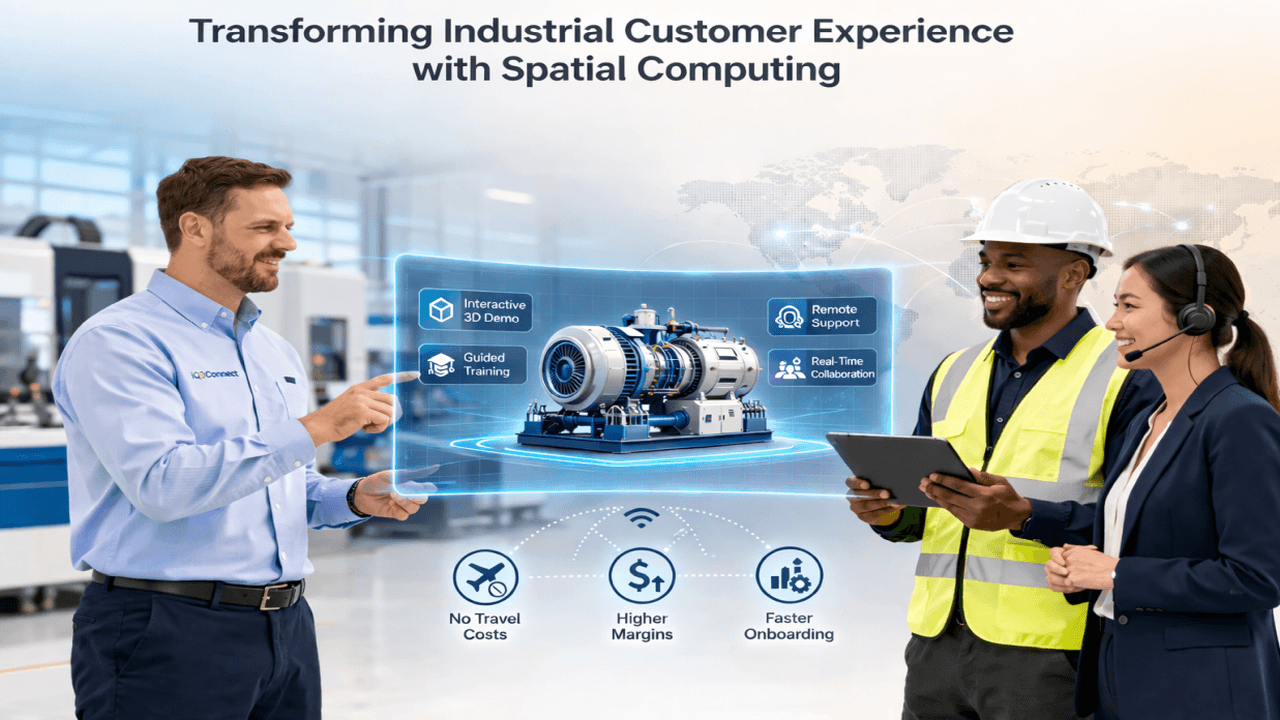
This is where iQ3Connect’s Spatial Learning Experience (SLX) transforms the equation.

SLX leverages immersive 3D environments and spatial computing to deliver:

Instead of flying teams across the globe, organizations can now bring customers into fully interactive digital environments—anytime, anywhere.


How iQ3Connect SLX Reduces Business Risk

1. Eliminates Travel Dependency

By replacing physical travel with immersive virtual experiences, SLX removes logistical bottlenecks and reduces exposure to disruption.

2. Standardizes Customer Experience

Every customer receives the same high-quality, guided experience—eliminating variability across regions and teams.

3. Accelerates Sales Cycles

Interactive, on-demand demos allow prospects to engage faster and make decisions sooner.

4. Enhances Training Outcomes

Hands-on, experiential learning improves retention and reduces errors in real-world operations.


Driving Margin Expansion Through Digital Transformation

Travel reduction alone can significantly improve margins—but SLX goes further.

Cost Savings

  • Reduced travel and logistics expenses

  • Lower training and onboarding costs

  • Decreased reliance on physical assets

Revenue Growth

  • Higher conversion rates from immersive demos

  • Expanded reach to global customers

  • Faster deal velocity

Operational Efficiency

  • Scalable delivery of training and support

  • Better utilization of expert resources

  • Reduced downtime for customers

Deloitte notes that companies enhancing digital customer experience often achieve greater margins and improved operational performance—a direct result of these efficiencies. (OpenText)


Increasing Customer Productivity at Scale

Modern customers don’t just want products—they want outcomes.

SLX enables customers to:

  • Learn faster through immersive, hands-on experiences

  • Access training on-demand, without scheduling delays

  • Troubleshoot issues in real-time virtual environments

  • Collaborate with experts remotely

The result is higher customer productivity, faster adoption, and stronger long-term relationships.


Future-Proofing Industrial Businesses

The industrial sector is at an inflection point. Digital leaders are not just adopting new tools—they are redefining how business is done.

To stay competitive, organizations must:

  • Put the customer at the center of digital transformation

  • Invest in scalable, immersive technologies

  • Reduce reliance on legacy, travel-heavy processes

  • Build resilient, digitally enabled operations

As Deloitte emphasizes, companies that deliver personalized, seamless digital experiences will be the key differentiators of the future. (Deloitte)


Conclusion: From Disruption to Opportunity

Business disruption—whether from global events, supply chain volatility, or evolving customer expectations—is here to stay.

The question is not whether to adapt, but how quickly.

iQ3Connect’s SLX platform offers a powerful path forward:

  • Reduce business risk by eliminating travel dependencies

  • Increase margins through operational efficiency

  • Boost customer productivity with immersive digital experiences

In a world where digital customer experience defines success, spatial computing is no longer a vision of the future—it’s a strategic imperative.


Ready to Transform Your Customer Experience?

Discover how iQ3Connect SLX can help your organization drive growth, resilience, and competitive advantage in the digital era.

Monday Morning Coffee Blog – iQ3 Beginnings

Each Monday iQ3 will post content related to iQ3, the XR market, or the industries we serve. This interview with iQ3’s Founder and CEO outlines how iQ3 started, where he answers:

1) What started iQ3?
The vision to provide simple and cost effective XR to enterprises by enabling the use of the relatively low-cost 3D interfaces hitting the market.

2) What did the initial release of iQ3 look like?
It was focused on collaboration with complex CAD data and used open standards to allow content to be accessed in VR via a web browser. The initial interface had 2 buttons, start meeting and join meeting.

3) What is the iQ3 philosophy?
To provide business value, the platform needs to be easy, fast, and scalable in an everyday business environment.

4) What is the most exciting part of this iQ3 journey?
To see iQ3 in production use and to deliver business value at scale.

For access to all of the iQ3Connect Monday Morning Coffee Blog posts, please visit our Vimeo showcase at vimeo.com/showcase/10303723

Monday Morning Coffee Blog – Applicable XR Content

Each Monday iQ3 will post content related to iQ3, the XR market, or the industries we serve. This post is intended to outline how iQ3 addresses the common XR adoption inhibitor of limited available XR content. iQ3 is democratizing XR by enabling anyone to create, edit, and deploy immersive reality experiences with their own or existing 3D content. Simply upload the content to the iQ3 Hub and then create an XR ready model with the click of one button.

For access to all of the iQ3Connect Monday Morning Coffee Blog posts, please visit our Vimeo showcase at vimeo.com/showcase/10303723

Monday Morning Coffee Blog – XR Device Requirements

Each Monday iQ3 will post content related to iQ3, the XR market, or the industries we serve. This post is intended to outline how iQ3 addresses the common XR adoption inhibitor of device requirements. The iQ3 platform is device agnostic, meaning that our adaptive screen technology enables XR experiences to be deployed on any combination of VR, AR, PC, and mobile devices. Being device agnostic reduces XR implementation cost and risk.

For access to all of the iQ3Connect Monday Morning Coffee Blog posts, please visit our Vimeo showcase at vimeo.com/showcase/10303723

Monday Morning Coffee Blog – Access and Deployment

Each Monday iQ3Connect will post content related to iQ3, the XR market, or the industries we serve. This post is intended to outline how iQ3 addresses the common XR adoption inhibitor of access and deployment. iQ3’s one-click access allows guests and trainees to enter a multi-user immersive meeting space or training.

Monday Morning Coffee Blog – Democratizing XR

Each Monday iQ3Connect will post content related to iQ3, the XR market, or the industries we serve. This post is intended to outline how iQ3C0nnect addresses the most common VR adoption inhibitor (cost) and our goal to democratize XR.

Monday Morning Coffee Blog – XR Adoption Inhibitors

Welcome to the iQ3Connect Monday Morning Coffee Blog where each week we will post content related to iQ3Connect, the XR market, or the industries we serve. This post is intended to outline the four common adoption inhibitors for XR in the industrial and manufacturing industries.

– Cost (XR expertise)

– Access & Deployment

– Device requirements

– Applicable content

Monday Morning Coffee Blog – XR in Manufacturing

Welcome to the iQ3Connect Monday Morning Coffee Blog where each week we will post content related to iQ3Connect, the XR market, or the industries we serve. This post is intended to outline how extended reality fits into the manufacturing space.

Monday Morning Coffee Blog – XR News

Welcome to the iQ3Connect Monday Morning Coffee Blog where each week we will post content related to iQ3Connect, the XR market, or the industries we serve. This post is intended to outline a few of the news sources that our iQ3 team uses to stay on top of what is going on in the XR industry.

Icon

Form Submitted!

Thanks for submitting the form. An iQ3Connect representative will be reaching out to you shortly. In the meantime, please feel free to review some of our resources below.

Icon

Form Submitted!

Thanks for submitting the form. An iQ3Connect representative will be reaching out to you shortly. In the meantime, please feel free to review some of our resources below.

Icon

Form Submitted!

Thanks for submitting the form. An iQ3Connect representative will be reaching out to you shortly. In the meantime, please feel free to review some of our resources below.

Icon

Form Submitted!

Thanks for submitting the form. An iQ3Connect representative will be reaching out to you shortly. In the meantime, please feel free to review some of our resources below.