AI Factories Need More Than Compute: How Digital Twins Are Reshaping Operations and Workforce Training


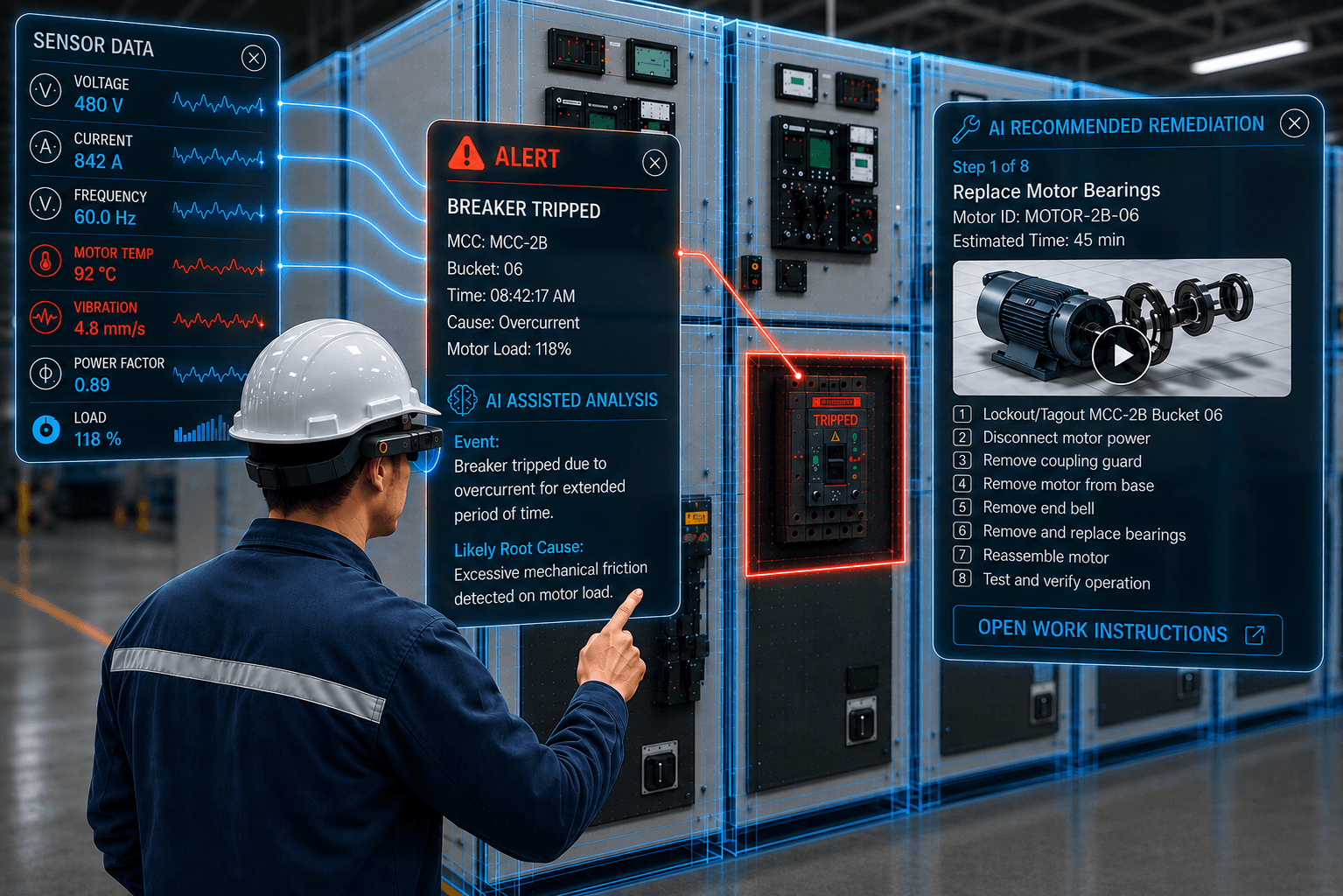
AI factories are emerging as the next generation of industrial infrastructure. But as organizations invest in GPUs, power, cooling, networking, and increasingly sophisticated facilities, another challenge is coming into focus: how will the workforce be prepared to operate and maintain these complex environments?
The AI industry is moving rapidly from experimentation toward large-scale infrastructure.
NVIDIA’s latest generation of AI-factory architecture is designed to bring together computing, networking, storage, power, cooling, and software into highly optimized environments for large-scale AI workloads. Its Vera Rubin platform is being positioned to support some of the world’s largest AI factories, while the NVIDIA DSX platform provides a reference architecture for designing and operating them. At GTC 2026, NVIDIA made this concrete by releasing the Vera Rubin DSX AI Factory reference design and taking the Omniverse DSX Blueprint to general availability, giving operators a fully compatible pairing of physical reference architecture and digital-twin environment for design, buildout, and operations.
Much of the conversation naturally focuses on the technology that makes these facilities possible: GPUs, high-density racks, power distribution, liquid cooling, networking, and AI software.
But there is another part of the AI-factory equation that deserves more attention:
The people who design, operate, maintain, troubleshoot, and continuously improve these environments.
As AI infrastructure becomes more complex, organizations will need new ways to prepare their workforce.
This is where digital twins and immersive learning can play an increasingly important role.
A digital twin can provide more than a digital representation of an AI facility. It can become a foundation for simulation, collaboration, training, maintenance, and operational knowledge.
What Is an AI Factory?
The term “AI factory” describes a new approach to infrastructure built specifically around the production and delivery of AI workloads.
Traditional data centers support a broad range of computing needs. AI factories, by contrast, are designed around accelerated computing and the infrastructure required to process enormous volumes of data and produce AI outputs at scale.
The “factory” analogy is deliberate.
Instead of manufacturing a physical product, an AI factory takes inputs such as data, electricity, and computing resources and produces outputs such as AI models, inference, tokens, and other forms of machine-generated intelligence.
NVIDIA’s current AI-factory architecture brings together the computing, networking, storage, and infrastructure required to optimize these workloads at scale.
But an AI factory is not purely digital.
Behind the AI models and software is a physical environment containing high-density computing systems, electrical infrastructure, cooling systems, networking equipment, monitoring systems, and other critical assets.
And those assets need people.
AI Factories Are Industrial Systems, Not Just Data Centers
As AI workloads become more demanding, the physical infrastructure supporting them is becoming increasingly sophisticated.
AI factories can involve:
- High-density GPU and computer systems
- Advanced electrical distribution
- High-capacity power infrastructure
- Direct-to-chip and other liquid-cooling technologies
- High-speed networking
- Thermal management
- Monitoring and control systems
- Physical security and safety systems
- Maintenance and operational procedures
These systems cannot be treated independently.
A change in computing density can affect power requirements. Power requirements can affect thermal loads. Thermal loads can influence cooling infrastructure. Cooling, electrical, networking, and computing systems all have to work together reliably.
This makes the design and operation of an AI factory an increasingly complex engineering challenge.
Schneider Electric’s collaboration with NVIDIA illustrates this shift. In March 2026, the companies announced validated blueprints covering the design, simulation, building, operation, and maintenance of gigawatt-scale AI factories. Schneider Electric and AVEVA are also working with NVIDIA on lifecycle digital-twin architecture for large-scale AI factories — AVEVA has integrated its CONNECT industrial intelligence platform and engineering and operations software directly into the Omniverse DSX Blueprint, alongside strategic partners Schneider Electric and ETAP, to create physical and digital modules that can be deployed across the full AI-factory lifecycle.
Schneider’s AI-factory solutions now bring together power, liquid cooling, prefabricated infrastructure, software, and digital-twin capabilities for high-density AI environments.
The important point is that the AI factory is being treated as a lifecycle engineering and operations challenge, not simply as a collection of servers.
That creates a natural role for digital twins.
Why Digital Twins Matter for AI Factories
A digital twin creates a digital representation of a physical asset, system, or environment.
For AI factories, the value of a digital twin can extend far beyond simply viewing a 3D model.
It can help organizations understand how different parts of the infrastructure interact and explore potential scenarios before making changes in the physical environment.
Design
Engineering teams can use digital representations to visualize and evaluate infrastructure before construction.
Simulation
Power, cooling, thermal, and other operational scenarios can be modeled to help identify potential issues and optimize designs.
Collaboration
Teams in different locations can review and interact with the same digital environment rather than relying solely on drawings, screenshots, or static documentation.
Operations
Digital information can provide a shared view of complex infrastructure and support operational decision-making.
Maintenance
Technicians can use digital representations to understand equipment, procedures, and maintenance requirements.
This is already becoming part of the AI-factory ecosystem where NVIDIA has highlighted digital twins for AI-factory design and simulation, including the use of NVIDIA Omniverse and partner engineering technologies to model infrastructure and power requirements. NVIDIA’s Omniverse DSX Blueprint is also designed to support digital twins for large-scale AI-factory design and simulation, with industry leaders including Schneider Electric, Siemens, PTC, Eaton, Vertiv, Trane Technologies, and others.
This points toward an important evolution:
The digital twin is becoming part of the AI-factory lifecycle.
But there is one stage of that lifecycle that is easy to overlook.
The people who need to learn how to operate it.
The Missing Layer: Training the AI Factory Workforce
An AI factory can contain highly specialized systems that employees cannot simply learn by reading a manual or watching a presentation.
Consider the range of people involved:
- Engineers designing and validating infrastructure
- Technicians maintaining equipment
- Operators monitoring systems
- Safety teams preparing workers for high-risk situations
- Contractors working on specialized systems
- Remote experts supporting field teams
- New employees learning unfamiliar facilities
All of these roles require knowledge of the physical environment.
And as infrastructure becomes more complex, that knowledge becomes harder to communicate using traditional methods alone. NVIDIA itself has pointed to this gap directly: industry research indicates that a lack of AI skills is the primary reason companies are unable to achieve business value from AI, which is why the company built its Deep Learning Institute to deliver hands-on training at scale — a program that has already reached more than 183,000 students and runs onsite workshops with organizations like Lockheed Martin, Adobe, and Cisco.
This creates an interesting opportunity:
What if the same digital environment created for engineering and simulation could also become a training environment?
This isn’t just a hypothetical — it’s already happening inside NVIDIA’s own manufacturing ecosystem. At its new Houston facility, Foxconn engineers used digital twins built on NVIDIA libraries and open models to design and validate both the physical plant and the AI and robotics systems that support factory workers, and that same digital environment now powers interactive AI coaches that help train new employees. Wistron took a similar approach with its Fort Worth facility, which was designed first as a digital twin built on NVIDIA AI and Omniverse libraries before a single system was assembled on the factory floor.
Instead of separating engineering data from workforce training, organizations could use digital twins as a bridge between the two.
A technician could explore a digital representation of a facility before entering it.
An engineer could use the same environment to explain a system to an operator.
A safety team could create a simulation of a hazardous scenario without exposing workers to the real-world risk.
A maintenance team could practice a procedure before working on operational equipment.
The digital twin becomes more than a model.
It becomes a place to learn — a shift NVIDIA has described in its own research on industrial digital twins, noting that physically accurate virtual replicas of real-world environments and processes serve as the training ground that helps AI agents, autonomous systems, and robot fleets operate safely and reliably before ever touching the real world. The same logic extends naturally to the humans working alongside those systems.
From Digital Twin to Training Environment
The concept becomes particularly powerful when digital twins are combined with interactive and immersive learning.
Consider a technician preparing to perform maintenance on a complex system.
Instead of beginning with a static manual, the technician could:
- Locate the equipment within a digital representation of the facility.
- Explore the relevant components.
- Identify the parts involved in the procedure.
- Follow the maintenance sequence step by step.
- Practice the procedure virtually.
- Complete an assessment to demonstrate understanding.
- Transition to the physical equipment with greater familiarity.
The objective isn’t to replace hands-on experience.
It is to make that hands-on experience safer, more targeted, and more effective.
Equipment familiarization New employees can explore complex equipment and facilities before entering the physical environment.
Maintenance training Technicians can rehearse procedures using digital representations of real equipment.
Safety training Organizations can simulate hazardous or unusual scenarios in a controlled environment.
Troubleshooting Workers can practice identifying faults and following the correct response procedures.
Remote collaboration Experts can join a shared 3D environment to guide teams in another location.
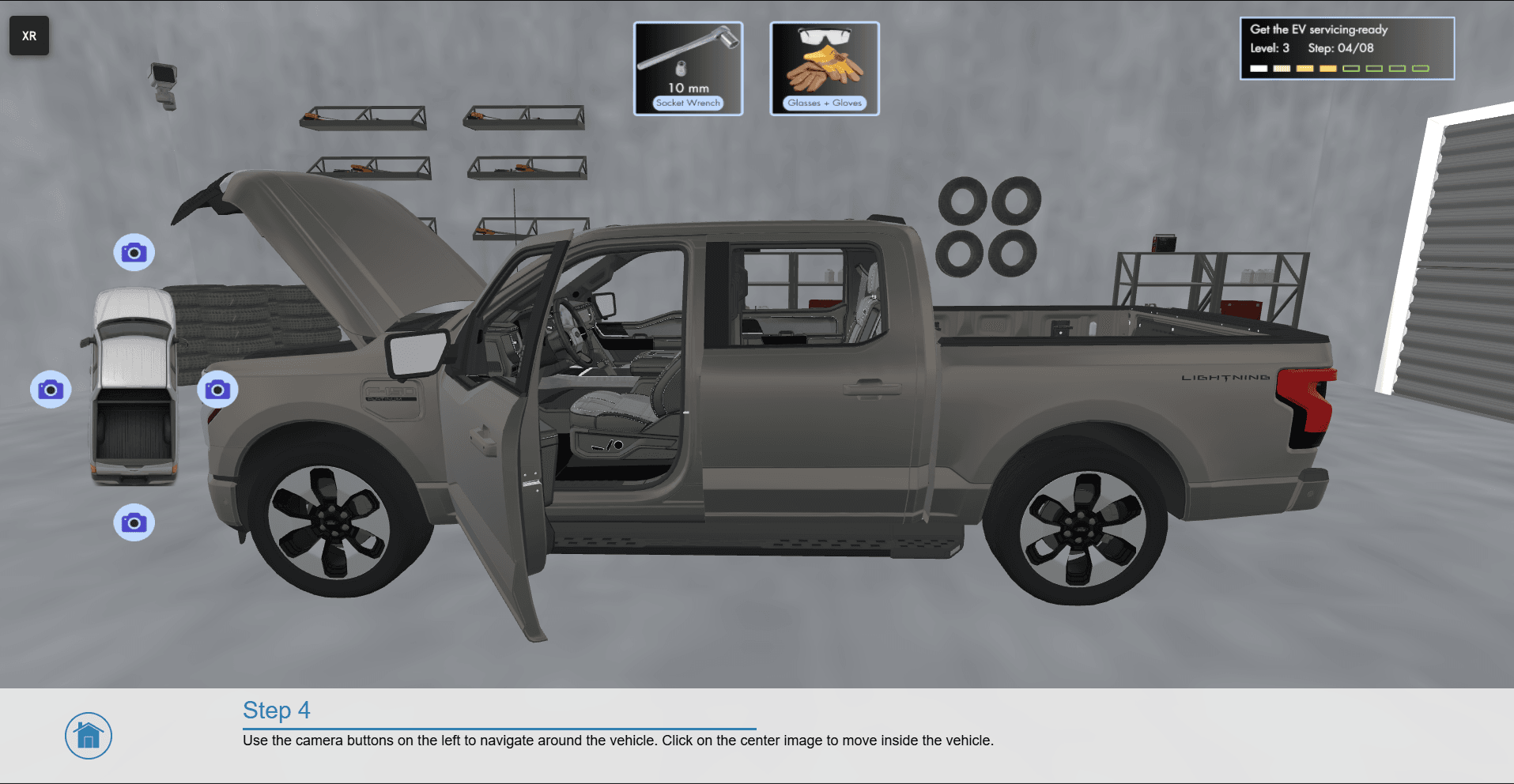
Interactive work instructions Static manuals can evolve into contextual, step-by-step 3D instructions.
Together, these applications create a connection between digital twins, workforce training, and operations.
Why Immersive Learning Makes Sense for Complex Infrastructure
Immersive learning is not about using VR simply because VR is new.
Its value comes from making complex information easier to understand and interact with.
Industrial equipment is inherently spatial.
A conventional manual may describe a sequence of steps, but the learner still has to mentally translate those instructions into the physical environment.
An interactive 3D experience can make those relationships more intuitive.
A learner can see:
Where the equipment is → what components are involved → what needs to move → what needs to be inspected → what sequence needs to be followed.
This can be particularly valuable when the real equipment is:
- Expensive
- Operationally critical
- Difficult to access
- Located in another facility
- Dangerous to use for repeated training
- Required for production
Immersive training can provide a safe environment for repetition before the learner works on the physical system.
And immersive does not necessarily mean fully virtual.
Training can take different forms depending on the task and the device available.
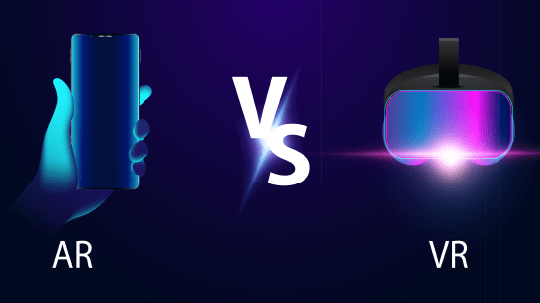
3D Interactive Training Learners can explore equipment and procedures through a PC, tablet, or mobile device.
Augmented Reality Workers can access instructions and digital information while interacting with physical equipment.
Virtual Reality Learners can enter a fully immersive digital environment and practice procedures at 1:1 scale.
The important point is flexibility.
The training experience should adapt to the workforce — not the other way around.
Immersive Training Doesn’t Have to Mean a VR Headset
One of the biggest barriers to enterprise XR adoption is the assumption that every employee needs specialized hardware.
That is rarely practical.
An engineer may spend most of their day at a workstation.
A technician may use a tablet on the factory floor.
A field worker may use a mobile device or AR hardware.
A training center may use VR headsets.
If immersive learning is limited to one type of device, organizations can quickly run into deployment and scalability challenges.
This is where browser-based XR becomes interesting.
A browser-based approach can allow the same underlying experience to be accessed across different devices without requiring every user to install a specialized application.
For enterprise environments, this can simplify deployment and make immersive experiences available to a much wider workforce.
iQ3Connect follows this approach by allowing organizations to create interactive 3D training and experiences that can be accessed through modern web browsers across desktop, mobile, AR, and VR devices.
That means an organization can use the same core content in different ways.
PC for learning. Tablet for guided work. AR for field instructions. VR for immersive simulation.
The headset becomes an option — not a requirement.
From Engineering Data to Workforce Readiness
This leads to a broader opportunity for industrial organizations.
Today, engineering, simulation, training, and operations are often treated as separate activities.
But the AI-factory model creates an opportunity to connect them.
Consider the following lifecycle:
Engineering Data
↓
Digital Twin
↓
Simulation
↓
Immersive Training
↓
Interactive Work Instructions
↓
Operations & Maintenance
↓
Knowledge Capture
The same 3D and engineering data that helps teams understand an asset can potentially become the foundation for training and operational support.
This is particularly relevant as digital-twin initiatives move toward lifecycle applications.
Schneider Electric and NVIDIA’s work around lifecycle digital twins for AI factories demonstrates how the technology is expanding beyond isolated design models toward environments that support design, simulation, operations, and maintenance.
The next opportunity is to extend that lifecycle to the workforce.
Where iQ3Connect Fits
This is where platforms such as iQ3Connect can help organizations turn the concept into practical training and operational experiences.
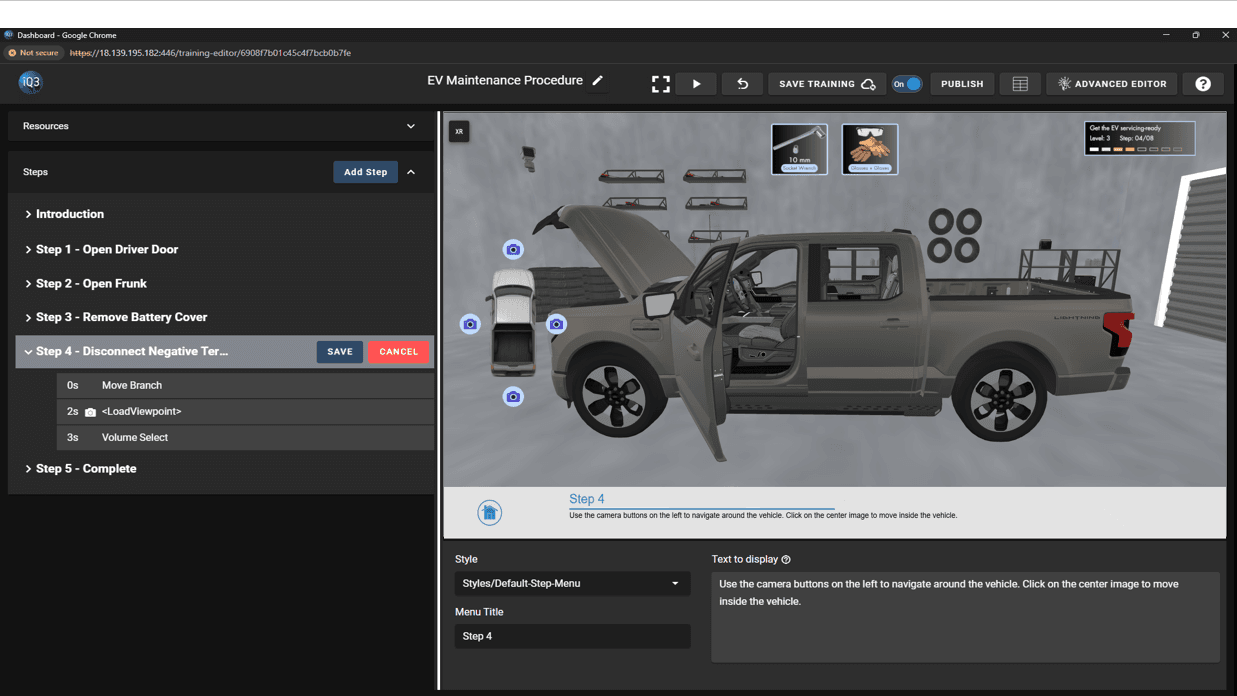
iQ3Connect enables teams to transform 3D models, CAD data, documents, videos, and other content into interactive training, guided work, and collaborative 3D experiences through a no-code authoring environment.
Its digital-twin capabilities allow organizations to bring 3D CAD, point-cloud data, 360-degree content, documents, and other assets into browser-based environments that can be accessed across PCs, tablets, mobile devices, AR, and VR.
For workforce training, this can support applications such as:
- Equipment operation training
- Maintenance and repair training
- Safety and HSE training
- Interactive 3D manuals
- AR work instructions
- VR training on digital twins
- Remote collaboration
- Virtual facility walkthroughs
For example, a complex piece of infrastructure can be transformed from an engineering model into an interactive learning environment.
A technician can explore the equipment, follow a procedure, practice the required steps, and access the experience from the device most appropriate for their role.
iQ3Connect also supports integration with learning management systems, allowing immersive training to become part of existing enterprise learning workflows rather than operating as a separate system.
This creates a potential bridge between engineering data and workforce readiness.
The AI Factory Workforce Will Need a New Training Model
The AI-factory era is still developing.
But the direction is becoming increasingly clear.
AI infrastructure is becoming larger, denser, more specialized, and more tightly integrated with physical infrastructure.
NVIDIA’s current AI-factory roadmap is expanding toward massive systems designed for agentic AI, while new AI-factory projects are emerging around the world. In July 2026, NVIDIA announced it is partnering with Noetra Corp. to build a national AI infrastructure initiative in Japan, built around a Vera Rubin AI factory with 27,500 Rubin GPUs, 13,750 Vera CPUs, and 140 megawatts of data-center capacity — supported by Japan’s Ministry of Economy, Trade and Industry as the computing foundation for the country’s FRONTia Project, aimed at strengthening the AI ecosystem across manufacturing, logistics, and healthcare.
At this scale, workforce readiness becomes a strategic consideration.
Organizations will need people who can:
- Understand complex infrastructure
- Operate advanced systems
- Follow precise procedures
- Troubleshoot equipment
- Respond to safety scenarios
- Maintain critical assets
- Collaborate across locations
- Continuously learn as systems evolve
Traditional training will remain important.
But digital twins and immersive learning can add another layer — one that connects training more closely to the actual environments in which people work.
The Future of the AI Factory Is Also About Human Capability
The AI-factory conversation will understandably continue to focus on computers.
GPUs, networking, power, cooling, software, and infrastructure are fundamental to building AI at scale.
But infrastructure alone does not operate itself.
Behind every AI factory is a workforce responsible for designing, commissioning, operating, maintaining, troubleshooting, and continuously improving it.
As AI infrastructure becomes more complex, organizations will need equally sophisticated ways to prepare that workforce.
Digital twins can provide the foundation.
Immersive learning can make that foundation interactive.
Browser-based XR can make those experiences accessible across different teams and devices.
Together, they can help connect the digital and physical sides of the AI-factory lifecycle.
The future of AI factories won’t be built by computers alone. It will be built by the combination of intelligent infrastructure and an AI-ready workforce.
And perhaps the next evolution of the digital twin is not simply to help organizations design the AI factory — but to help people learn how to operate it.
Explore how iQ3Connect can help transform engineering data and digital twins into interactive training, guided work, and collaborative experiences.
Sources referenced in this post:
- NVIDIA Releases Vera Rubin DSX AI Factory Reference Design and Omniverse DSX Digital Twin Blueprint — NVIDIA Investor Relations, March 2026
- AVEVA Develops New Lifecycle Digital Twin Architecture for Gigawatt-Scale AI Factories — AVEVA, March 2026
- Vertiv Introduces First Converged Physical Infrastructure Digital Twin for NVIDIA Omniverse DSX — Vertiv, June 2026
- Accelerating Industrial Digital Twins and Physical AI With OpenUSD — NVIDIA Blog
- Why Workforce Development Is Key to Reaping AI Benefits — NVIDIA Blog
- NVIDIA and Partners Build in America, for America — NVIDIA Blog, August 2026
- NVIDIA and Japan Launch 27,500-GPU Vera Rubin AI Factory — StorageReview, July 2026
Related Blogs
Enterprise XR in 2026: From Pilot Projects to Scalable Browser-based Infrastructure
AI factories are redefining industrial infrastructure through advanced computing, automation, and digital twins. As these environments scale, workforce training must evolve alongside them. Explore how digital twins and enterprise XR can help organizations train employees, simulate complex operations, and prepare teams for the future of AI factory operations.
Read More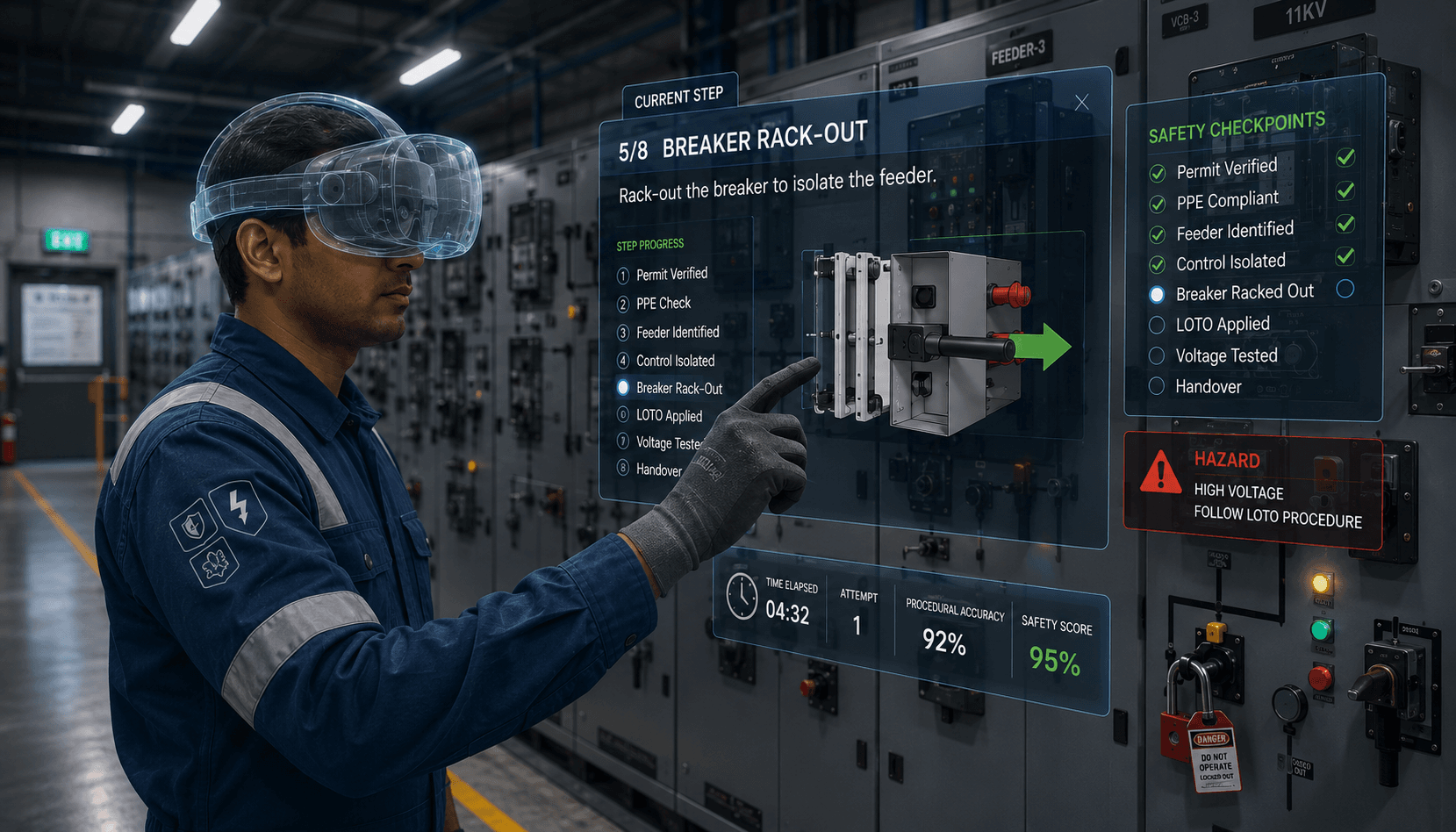
Case Study: VR Training for High-Risk Electrical Isolation & Lockout-Tagout (LOTO) Procedures in Oil & Gas Refineries
A Fortune 500 energy company transformed electrical isolation and Lockout Tagout (LOTO) training using iQ3Connect's browser-based VR platform. The solution standardized training across refinery sites, increased procedural retention by 40%, enabled three times more hands-on practice, and eliminated exposure to live electrical equipment during training.
Read More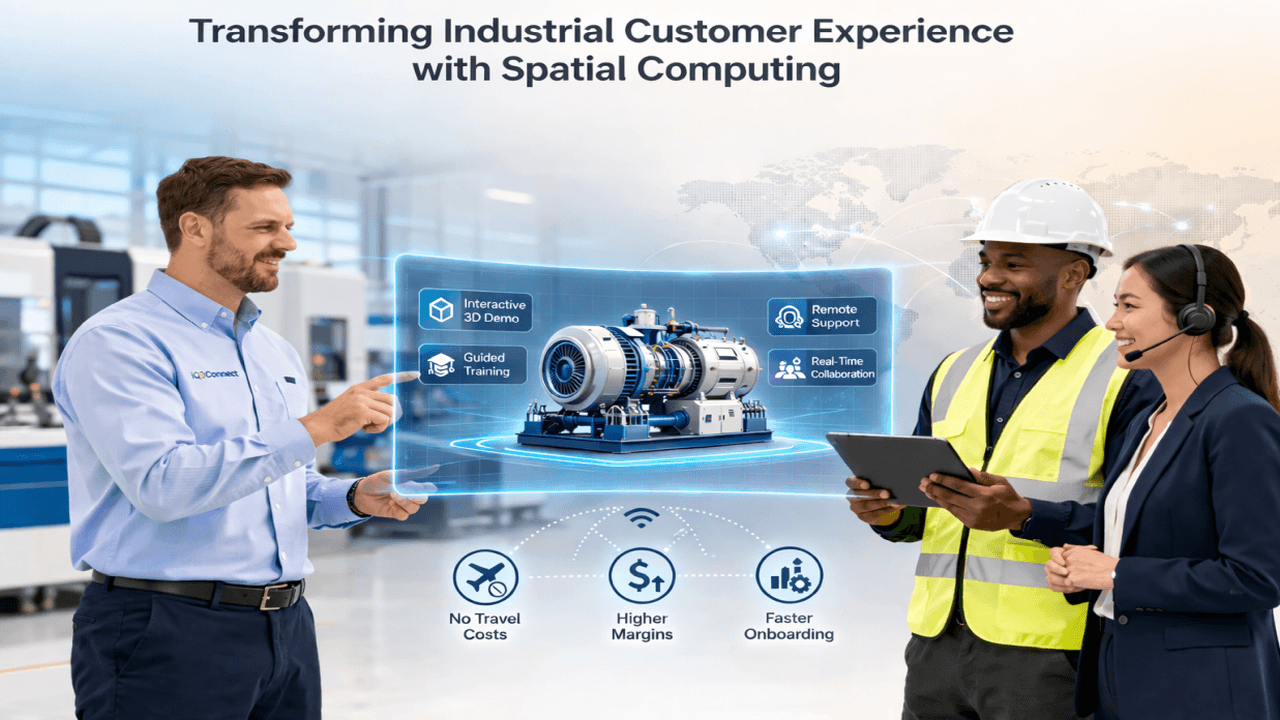
Digital Customer Experience in Industrial Manufacturing: How Spatial Computing Is Redefining Growth, Resilience, and Profitability
Industrial manufacturing and construction companies are undergoing a fundamental shift to digital customer experience (DCX) that are no longer optional—it’s “table stakes” for companies seeking growth, differentiation, and resilience.
Read More